At first when I had thought of making meatloaf, it was a bit intimidating. I thought, “Would I make it right;” “Would I put in the proper ingredients;” “Would my family like it the way I choose to make it or would they want it a different way;” “What was the best recipe…”? After much research for recipes online and in books, I chose one from a recipe book from Fort Loudon, PA. The meatloaf recipe was entered by my dad’s uncle, Uncle Percy “Bill”. Out of all of the recipes I came across, “Uncle Bill’s Favorite Meatloaf” recipe was worth a try. Uncle Bill even included a recipe for a piquant sauce to top off the meatloaf.
My Family’s Tastes
This seemed like a very simple recipe. Of course I had to alter it, and thought my family was sure to give it a thumbs up, or at least eat everything on their plate without complaining. I was originally not quite sure how the piquant sauce would go over with my picky eater. Therefore, I made that as an optional topper, to put on after cooking. After I made “Uncle Bill’s Favorite Meatloaf” and served it to my family with mashed potatoes and green beans or corn, my whole family decided they enjoyed this very much. My picky eater did not try it with the piquant sauce. The next time I made “Uncle Bill’s Favorite Meatloaf I included the piquant sauce on top before it went into the oven. That was not a hit for my picky eater, but the rest of my family enjoyed it very much.
“Uncle Bill’s Favorite Meatloaf” recipe is below, but meatloaf in general can be made a variety of ways. Some options include using a different meat. For example, instead of ground beef, use turkey for the meat. Another change is cubed bread crumbs or panko crumbs (I prefer panko). Most recipes include eggs; ketchup; brown sugar. To change it up, Uncle Bill suggested to use salsa instead of ketchup. Another option is to use steak sauce instead of ketchup. Some of my friends add vegetables to sneak into their kids’ diets (for those kiddos who don’t like vegetables). Meatloaf can bring out creativity while cooking.
Creative Meatloaf
One of my friends made meatloaf for April fool’s day for dinner. She put the meat into muffin cups before baking. After they came out of the oven she topped the meat muffins with prepared mashed potatoes, to resemble cupcakes with frosting on top. Of course, the baking time would need to be adjusted if using muffin cups versus using a loaf pan. The amount of time to bake would decrease, just be sure to check the internal temperature of the meat. It should be a minimum of 160 degrees. Let me know how you like “Uncle Bill’s Favorite Meatloaf” recipe or how you make it differently. Did you add the piquant sauce or use other ingredients or serve it with something different?
Recipe by Uncle Percy u0022Billu0022 HaysCourse: Meal Ideas for Picky EatersCuisine: American
Servings
4
servings
Prep time
15
minutes
Cooking time
1
hour
Total time
1
hour
10
minutes
Ingredients
1.5 lbs ground chuck
1/2 tsp pepper
1 tsp salt
1/2 cup milk
1/2 cup ketchup
2 eggs, beaten
1 tsp mustard
1/4 cup onion, finely chopped
3/4 cup dry bread crumbs
Directions
Soak bread crumbs in milk and ketchup for 15 minutes.
Mix chuck, pepper, salt, eggs, mustard and onion.
Add bread crumb mixture and mix well.
Bake in loaf pan at 325 degrees F for 1 hour.
If desired, add piquant sauce on top of meat loaf.
Notes
To make the piquant sauce, blend 3 Tbsp. brown sugar; 1/4 cup ketchup; 1/4 tsp. nutmeg and 1 tsp. dry mustard. Put on top of the meat. (I put it on before cooking).
“The father of godly children has cause for joy. What a pleasure to have children who are wise.”(Proverbs 23:24, NLT)
A Vet-themed birthday party is a fun option for an animal lover. My middle son has wanted to be a Vet since he was three years old. He loves animals, science, nature and learning what he can about all of those topics. Depending on the age level of kids for your party, there are many options for decorations, games, activities and favors. Your imagination is the limit as to what you can do.
The age level I was focusing on was 5-8 years old. Although, most of those kids were around 6 years old. I decided to have the kids pretend they were Vets and set up stations around the house. They pretended to be Vets, adopted a pet, crafted and played games.
Vet Name Tags
First, the kids had to identify themselves. They were each given a sticker name tag that had “Dr. ” written on it in permanent marker. The children participants could either write their name or have a grown-up write their name. Most of the kids were proud to wear their name tag sticker. However, some of the tags did not stay on their clothing very well. Another option is to write the name on a precut piece of card stock and slide it into the plastic sleeve of a pin name tag. Still another option, though pricey, is to personalize an appropriate-sized smock or lab coat.
Gearing Up
Once the kids were identified, it was time for them to gather their gear. Their ‘doctor’s bag’ was made out of a brown paper bag with handles. I cut out and taped a red plus sign to the outside of the bag. Inside their bag, each child had a clipboard and sharpened pencil. I purchased 6″x9″ hardboard clipboards. To each of the clipboards, I attached a blank check-up report.
The next step was to select their patients. I purchased small (4-5 inch) stuffed cats and dogs from Amazon and had the kids select which one they wanted to adopt. Then, they could pick out grooming supplies. A comb and a washcloth were available for each pet. After their grooming, each “doctor” selected a blanket to keep their pet cozy.
When their pet was chosen and “cleaned up,” the kids could decorate a crate and create a collar before the pet’s check-up. I set up a table with a fleece-lined vinyl tablecloth for crafting.
Make a Crate
For the crate, I purchased treat boxes, similar to these. My husband cut an oval hole in one side (short side) for the pet’s head to poke through. The party participants could decorate the “crate” if they wanted to. Some of the materials that were available to the kids included stencils, stickers, foam stickers, glitter glue, colored pencils, markers and crayons.
Make a Collar
For the collars, I offered chenille stems (pipe cleaners) and plastic beads. The pipe cleaners were like these. For the beads, I supplied pony beads in solid colors and translucent. I also included some letter beads, both round and in a cube. The kids could choose what beads to use. For instance, some spelled out the name they gave their patient while other kids put their own name on the collar. Some collars were very colorful, without any letter beads. **Tip- make the collar tight enough to twist the pipe cleaner around the stuffy’s neck. It should be secure and not be too loose to fall off. Don’t completely fill the pipe cleaner. The amount of beads will vary due to the beads selected. Some will be a little larger or smaller. Plastic cups were used by some of the kids to sort their beads.
Vet Check-up
Previously, my birthday boy had received 2 Melissa and Doug Examine and Treat Pet Vet Playsets. We used some of the tools from that for the party. Equipped with their doctors’ bags, clipboards and check-up checklist, the kids started the medical examination. The checklist included ears, eyes, heart, nose, paws and tail. First, for the ears, there were cotton swabs and wipes to clean out any dirt that might be there. There was also an Otoscope from the Vet Playset. Next on the check-up checklist were the eyes. They could use an Ophthalmoscope to look into the eyes. Also, there were pretend eye drops from a bottle to clean or medicate the eyes. Those two items for the eyes were also from the Vet Playset.
Heart Check
After checking the eyes, the next part for examination was the heart. For the heart, I made pretend stethoscopes for each party participant. I used a headband and attached a ribbon with hot glue. Two circles of the same size were cut from white felt. Likewise, two hearts were cut from blue felt. Then, the hearts were hot glued to each circle and the circles (wrong sides facing each other) were hot glued onto the end of the ribbon. I was not sure if the headbands would be bothersome to the ears of any children. Therefore, my husband acquired some unused foam earplugs and hot glued them to the tips of the headbands. They turned out to be bothersome to some of the children, while others actually wanted to keep theirs on. If you would like more specific instructions on how to make the stethoscopes, click here.
For the nose and mouth I supplied some tongue depressors. The paws were cleaned with a wipe before examining. Last on the check-up checklist was the tail. Various bandages, mostly cloth or self-adhesive wraps, could be used for the tail. My kids have put stickers and bandages on some stuffies before. They do not usually come off well. Also at the end I had a bin with other vet tools (like a syringe, arm cuff and tweezers, most from the Vet Playset.
Games and Other Activities
There are so many animal games and activities for parties. The party was inside, as it was in January and my age range was 2-8, most of the kids being 6. Activities that were simple and fun, but not too involved, was the way to go. I found a few that fit the bill, some of which we did at the party. First, there was animal charades. The party participants take turns to act out an animal and to guess what that animal is. The second activity was a porcupine quill removal. About 10 toothpicks were stuck into a ball of play dough. The kids had to use tweezers to pull them out, one by one. The third activity was to play a pin the tail on the cat game. The fifth was to decorate bird finger puppets. The kids were not interested in the porcupine game, nor charades.
Pin the Tail on the Cat
One game that they did enjoy playing was Pin the Tail on the Cat. On a poster board I drew a cat. The tail was also drawn in place so that the players knew where they were to place the tail. Before the party my husband so kindly cut tails out of different colored construction paper. Each child selected the tail they wanted and wrote their name on it before playing. For blindfolds we used strips of non-see-through material. Each player had their own blindfold, so as to not spread germs.
Bird Finger Puppets
The other activity the kids wanted to do was to decorate bird finger puppets. I folded the paper beforehand in various different colors. The kids colored them to resemble birds.
You can check out the how-to for this easy paper folding craft here.
Cake and Decorations
The cake and decorations for my son’s Vet party were fairly simple. He was fine with it. He selected the cupcakes. Also, he got to contribute and decide on some of the decorations.
For the cake, we ordered half chocolate and half vanilla cupcakes from a local grocery store. They had cute and fun faces of dogs and cats on top. Overall, cupcakes seem to be simpler to serve. Utensils (forks) for eating, a knife for cutting and a plate for serving are all not necessary with cupcakes. To keep everything simple, we did cupcakes and an ice cream cup.
The decorations were very simple. We taped pictures of animals on the walls around the party area. Some of the decorations were pages from a puppy-themed calendar. Other pictures that were taped to the walls were also of animals, but pictures that my son drew and/or colored himself.
My vet-aspiring son and his friends had a fun time with all of the activities. They enjoyed the food. The weather that day was unseasonably warm, for early January. After cake and ice cream the kids all decided to go outside to play in our backyard. When they were ready to leave, the kids had their treasures from the party. The crate, collar, patient (dog or cat stuffy), a stethoscope, an ice bag, the clipboard, a bird finger puppet, any prizes they won and some snacks went along with each party participant.
This was a fun party to put together. I learned how to fold paper into birds for finger puppets. Also, I learned how to draw a cat on a large poster board. I was grateful that my son joined in to decorating and choosing items for his party.
“Your righteousness is like the mighty mountains, your justice like the ocean depths. You care for people and animals alike, O LORD.” (Psalms 36:6, NLT)
A dishcloth and pot scrubber are two of the most useful and simple items to knit. These two items are very practical and used by almost every adult. I like to make sets of dishcloths and pot scrubbers that coordinate with each other. Together, they are good to sell as a set or to give as gifts.
Dishcloth Pattern Options
There are so many patterns for pot scrubbers and even more for dishcloths. Some create a simple cloth. Other patterns give a textured finish to the dishcloth. Still more patterns for dishcloths create designs, such as letters, animals or other objects. Personally, for a dishcloth, I prefer a simple cloth with a garter stitch border. It is soft, easy to remember the pattern and knits up rather quickly.
Dishcloth Yarn Options
There are so many options of yarn to use. Natural fibers work best for this project, especially 100% cotton. However, they are typically a little more expensive than acrylic. Some of my favorites to use for this include Lily Sugar ‘n Cream, Peaches and Cream and Bernat Handicrafter cotton. These tend to be more economical, come in a variety of colors, and create a more durable product. Besides purchasing online, I purchase most of my yarn in local stores. For instance, I buy Lily Sugar ‘n Cream, Super Size, at Joann. Additionally, Peaches and Cream is found at Wal-mart. Bernat Handicrafter cotton is more difficult to find. I used to purchase it in 608 yards (for variegated yarn) and 710 yards (solid colors). Now I can only find those skeins online, and in limited quantities. I find smaller skeins in some stores.
The pot scrubbers are very simple. I use the same cotton yarn that was used for the dishcloths. Additionally, I use a coordinating textured yarn. Both yarns are held together when making the pot scrubber. For instance, with a solid red cotton yarn I join a red, white and blue scrubby yarn. Another combination I made was a green, magenta, blue and orange scrubby yarn with an orange and white variegated cotton yarn.
As I previously mentioned, there are various patterns for dishcloths with different sizes and designs. Likewise, with the pot scrubbers, there are several patterns. I have tried several sizes and designs. I came up with works best for me for both the dishcloth and the pot scrubber. I found many dishcloth patterns to be too large or were unnecessarily decorative for daily use. I came up with a pattern for both the dishcloths and the pot scrubbers that work well for me.
Make a 100% cotton dishcloth. It is a very useful and versatile item. A dishcloth makes a nice house warming gift (in the recipient's favorite color or the color of their plates or decor). It is also good for your own use. A beginner pattern, this is easy to do and easy to remember. If desired, you can make a coordinating pot scrubber to go along with it. You can find that pattern on the same post.
Active Time1 hour
Total Time1 hour
Materials
100% worsted cotton yarn, such as Lily Sugar ‘n Cream or Bernat Handicrafter Cotton
Tools
US 7 knitting needles
stitch counter
scissors
tapestry needle, for weaving in ends
Instructions
CO 36 stitches
Rows 1-5, K
Row 6 and all even rows to 42: K 4, P to last 4, K 4
Row 7 and all odd rows to 41: K across
Row 43-48: K across
BO all stitches in Knit
Weave in ends
Notes
CO: cast on
K: knit
P: purl
BO: bind off
Many worsted 100% cotton yarns will work to make this item. Stick with cotton, for the durability and the best material for this finished item. As far as needles, straight, double pointed or circular will work. I like to use 2 double pointed needles, with stoppers at the ends so that the yarn does not slip off the end. 71 yards of yarn (A 42.5 gram skein of Bernat handicrafter cotton yarn) can make one and a half dishcloths. If you would like to make a coordinating pot scrubber, only make 1 dishcloth from the skein. Then, use the remaining yarn, held together with a coordinating scrubber yarn to knit up the pot scrubber. Most cotton yarns will suffice for this pattern. If desired, you can be more eco-friendly and use organic cotton, recycled cotton or a cotton blend.
Finished dimensions of the dishcloth are roughly 8 inches by 8 inches. If a different-sized finished product is desired, increase or decrease the amount of cast on stitches. Also, to keep it square, continue in pattern until height is one less inch than width. (For example, if the width is 9 inches, continue in the pattern until the height is 8 inches.). Then, finish as the pattern is written. For instance, finish with the 5 row knit border before binding off in knit.
Yield: 1 pot scrubber
Easy to Knit Pot Scrubber
Hand knit a pot scrubber to help clean pots, pans, baking sheets and more. Useful when a cleaning an item that needs more than a dishcloth but not quite steel wool. 100% cotton, this cleans with a scratch-free finish. If you are making a set with a dishcloth, use the cotton yarn used to make the dishcloth. In addition, use a coordinating scrubber yarn, held together, to create this item.
Active Time30 minutes
Total Time30 minutes
Materials
100% cotton yarn, in worsted weight
100% cotton scrubber yarn, (such as Red Heart’s Scrubby or Yarn Bee’s Scrub-ology) in a color that coordinates with the worsted weight cotton yarn, if making a set
Tools
US 7 needles, either straight needles, circular or double points with stoppers on the ends
scissors
stitch counter
tapestry needle for weaving in the ends
Instructions
With cotton yarn and cotton srubber yarn held double, CO 15 stitches.
Rows 1-30: Knit every row
BO in knit
Notes
If a smaller pot scrubber is desired, cast on 10 stitches and knit to row 20. Together with the dishcloth, this makes for a nice housewarming gift. Another idea is to gift this to a student going off to college or venturing away from their parents' house for the first time.
“No one is holy like the LORD! There is no one besides you; there is no Rock like our God.” (1 Samuel 2:2, NLT)
Cozy slippers are great for any season. Wearing them around the house keeps the chill off the feet. I wanted to create something to keep my family’s feet comfortable when walking inside our home. Hand-knit slippers look cozy and fairly simple to make. I like to look through knitting ideas and patterns on Ravelry and Pinterest.
A Popular Slipper Pattern
A granny-type slipper is very popular on Ravelry and Pinterest. Going through Ravelry, I stopped counting after I passed over 20 individual patterns for a similar slipper. I wanted to try out some of the patterns. All of the patterns for this slipper that I found are for 2 straight needles. It is knit flat in one piece. Then the toe and front area of the foot is pulled together and seamed. Finally, the heel is stitched together. Each of the patterns are very similar, but differ slightly. One difference is the needle size used. Another way is how many stitches are cast on. Also, where to stop the garter section and begin the ribbing differs in some patterns. After reading through many of the specific patterns, I decided to try two different ones.
Make-up of the Slippers
In these patterns, the body of the slipper is in garter stitch, while the toe is ribbed. The garter body gives this slipper a snug fit around the foot. The ribbed foot section allows for some stretch to fit many foot widths. This type of knit slipper is easily tucked into a pocketbook or backpack to take along! Some examples of places include the nursery at church; visiting friends or family; or anywhere you feel comfortable wearing them.
Choose a Pattern
One of the patterns I chose to make was, “Family Slippers,” by Churchmouse Yarns & Teas. The other pattern was, “Aunt Maggie’s slippers,” by Bev Qualheim. Of the 2 of those, I prefer “Aunt Maggie’s.” I can remember that pattern easier. The “Churchmouse” pattern had better additional information. The only reason I prefer “Aunt Maggie’s” is because “Churchmouse’s” uses markers. I sometimes use stitch markers. However, for some reason in this pattern, I kept losing my count when I slipped the markers. Subsequent times of making this pattern, I omitted the markers and had no issues.
Aunt Maggie’s pattern has instructions to knit for children, women and men sized slippers. Likewise, Churchmouse’s pattern offers instructions for sizes small, medium and large women’s slipper. The children and small sizes are very similar. Similarly, medium and women sizes are alike. Also, the men and large sizes are similar. Both of the finished projects created a comfortable piece of footwear. The “Churchmouse” pattern made a 3 ¼ inch high side to the slipper. However, the “Aunt Maggie’s” was slightly shorter at 2 7/8 inches high.
Both pattern instructions call for two strands of worsted weight yarn, held double. This equates to a bulky weight yarn, which is also an option of yarn to use. The writer of “Aunt Maggie’s,” Bev Qualheim, mentions to use a single strand of worsted weight yarn for a lighter slipper. However, like her, I prefer 2 strands of worsted, held double, for extra warmth. Worsted weight yarn held double also creates a thicker, more durable, finished product.
Select Yarn
I chose to use 100% acrylic yarn. This fiber is easily laundered. Wool yarn gives a warmer product. Superwash merino wool is washable and warm. However, my final decision came down to the acrylic. That fiber is washable, available in my area, and more cost-effective. Also, acrylic comes in very many color options and finishes.
Decide on Materials to Knit Slippers
To begin, I chose a printed yarn and a solid color that coordinates with it. There are many brands of acrylic yarn locally for me to choose from. A few include Red heart, I Love this Yarn, Yarn Bee, Caron, Big Twist, Loops & Threads, Crafter’s Secret, Lion Brand and Bernat.
Follow the Pattern
The beginning of the pattern is very simple. Just cast on the amount of stitches necessary for the size of the foot. Most of this section of the pattern is made with knit stitches on the front and back, creating the garter stitch. Two purl stitches are used on every wrong side of the slipper to create the bottom edges of the slipper. The next section of this pattern is to knit a ribbed pattern for the toe area. The ribbing creates a more stretchy material for various foot widths.
Be Safe Wearing Slippers
Though they can be worn on any type of flooring, I strongly recommend keeping safety in mind. One way to be safe is to only wear these slippers on carpet. They tend to be very slippery on hard floors. Another option for safety is to add a non-skid finish. The person wearing the slipper could very easily fall while wearing these. The carpet-type floors provide some traction.
Options to Add
I have seen many options to make slippers anti-skid. One of the options I saw was to attach a non-skid pad or patch to the underside of the slipper, under the ball of the foot. Another option is anti-skid gripper fabric. This is usually found in craft stores. Something else for anti-skid is fabric paint. There is a product called “Sock Stop” that is a fabric paint made specifically for this issue. Some have suggested plasti-dip. Alternatively, puffy paint can be used on the underside of the slipper. Similarly, hot glue added in designs or shapes on the underside of the slipper creates an anti-slip surface. One more option to use is non-skid shelf liner, cut to fit the slipper. There are more options and ideas that creative people have come up with. Share any ideas you have.
“How beautiful on the mountains are the feet of the messenger who brings good news, the good news of peace and salvation, the news that the God of Israel reigns!” (Isaiah 52:7, NLT)
My desire to knit the garter rib baby blanket came as a request from a friend. My friend got married when she was 28. She and her husband wanted to have children. She loves on other people’s kids all of the time. Though, they both desired to have their own children. However, due to medical issues, they were not able to have their own children. They did not feel that adoption was right for them.
Exciting News
Having had some fertility issues of my own, I empathized with her. I believe in the power of prayer. I knew how much it was a desire of their hearts to have children. All I knew to do to help them was to put it in God’s hands. I began praying intently for that. I continued to pray for almost 3 years. Then, one evening, I was told some fabulous news. Her husband told me to go ask her if she was pregnant. Without giving it much thought, I told him that it was not polite to ask women if they are pregnant. (Though, if I had thought about it for just one moment, I would have concluded that she is his wife. He loves her and would not intentionally want to bring any grief or pain to her.) He shrugged his shoulders and commented that she knew every time I was pregnant.
It was such a blessing to hear their wonderful news. She was so excited and he wanted to tell the world. I told her that I had been praying, and showed her the place in my prayer journal when I began to pray for her sweet baby. It was about two and a half years from the time I began to pray for them to when I heard they were going to have a baby.
Choosing the Baby Blanket Pattern
That evening, when I got home, I started to look through some baby blankets that I would like to make. I chose 10 patterns that I thought were nice. A couple of the patterns I had made before, or something similar. After saving a photo of the 10 blankets to my phone, I sent them to her, asking which she liked the best. Out of the 10 I sent, she decided that the Garter Rib Baby Blanket was perfect, in a cream color.
Requirements for the Garter Rib Baby Blanket
The garter rib baby blanket is simple enough for a beginner to make. There are only knit and purl stitches. The instructions include the amount of stitches required for the repeat. Therefore, it is easy to increase the width of the blanket, if that is desired. As written, the pattern calls for a DK (double knit) or a light worsted weight yarn. Size US 7 needles are suggested to create a finished blanket that is 30”x32,” using about 680 yards of yarn.
I went to Joann’s to find some yarn that would work with this pattern. Many of the brands and types of yarns that they had available I have used before for baby items. Most of the options on the shelf I have used several times and would use again. However, there were some that I won’t use again for baby items. The roving-type yarn did not work well for some projects I had worked on. Also, they were not fun for me to work with.
Selecting the Yarn
As my eyes scanned the baby yarn I noticed one that I had never used or noticed before. Bernat’s ‘bundle up’ yarn caught my eyes. I picked up a skein from the wire rack. The texture was so soft. Sometimes really soft yarns tend to get caught on my fingers. The fine fibers that create the soft texture cling to my dry hands. Bernat ‘bundle up,’ even as soft as it was, did not adhere to my skin. I do like to use Bernat brand for baby items. For instance, I have knitted baby blankets and many baby hats from Bernat’s ‘softee baby,’ ‘softee baby sparkle’ and ‘softee baby ombre’ yarns. Therefore, I quickly decided on Bernat ‘bundle up’ yarn.
As I mentioned before, the yarn that the garter rib baby blanket pattern suggests is a DK yarn. Though ‘bundle up’ is a baby yarn, it felt a little thicker and was labeled as a size 4 yarn. For the DK yarn the ball band suggests a size US 4-US 6 needle. However, to achieve the right tightness, or drape, the pattern suggests a size US 7 or US 8 needle. The ‘bundle up’ yarn, on the other hand, suggests using a size US 8 needle. Therefore, I should have went up to a size US 9 needle. That would have given the project a slightly different feel. However, I decided to use size US 8 needles. The blanket is so soft. Additionally, it will be very cozy and keep any baby warm.
Deciding a Size
The pattern calls for a cast on amount to be 123 stitches. However, that amount did not seem like enough stitches. I did not think the finished blanket was going to be wide enough. To increase the width, start with the 123 stitches, then add stitches in multiples of 6. For example, the next amount of cast on stitches would be 123 + 6. The cast on amount would be 129. Then, the next size up would be 135. You get that by adding either 123 + 12 or 129 + 6. The increases continue in that pattern. For instance, the next amount of stitches would be 141, then 147, followed by 153 and so forth. Because I used a size US 8 needle and did not size up to the size US 9, the blanket is not as wide as I would have liked. Even though I increased the amount of cast on stitches, the blanket width is about one inch to an inch and a half smaller than I would have hoped.
“‘Sir, do you remember me?’ Hannah asked. ‘I am the very woman who stood here several years ago praying to the LORD. I asked the LORD to give me this boy, and he has granted me my request. Now I am giving him to the LORD, and he will belong to the LORD his whole life.’ And they worshiped the LORD there.” (1 Samuel 1:26-28, NLT)
Bushkill Falls is a beautiful place to visit. My husband and I annually celebrate the anniversary of when we got engaged. We go out to eat at a well-known seafood restaurant. He had told me that he would propose before the end of that summer. As it so happened, he asked me to marry him on the very last day of summer. Every year, even during COVID, we celebrate our engagement.
The anniversary of our wedding, however, is not always celebrated the same. One year I had surgery a few days prior and was recovering. Another year our anniversary was a week after I had a baby. Though the remembrance of that day is very important to us, sometimes other events in life take priority over a celebration. When we do celebrate, we usually enjoy an outside activity and a nice meal.
Memorable Visits
There have been some memorable places we visited for our anniversary. One such location, which was on our first anniversary, was in New York state. The Finger Lakes offer beautiful sights and have a relaxed and laid-back feel. We stayed on Seneca Lake and visited Watkins Glen while we were there. Another location we went to is Wildwood Park. We had an adventure while we walked around the lake. One more area we hiked around was Pine Grove Furnace State Park. Additionally, we checked out Bushkill Falls as a location to celebrate our lives together. As the name suggests, there were many waterfalls to gaze upon along the trails. Bushkill Falls is also called the Niagara of Pennsylvania. This is due to the lovely waterfalls throughout the park. Some of the trails were wooden and built along and on top of the pathway.
“And because I preach this Good News, I am suffering and have been chained like a criminal. But the word of God cannot be chained. So I am willing to endure anything if it will bring salvation and eternal glory in Christ Jesus to those God has chosen.” (2 Timothy 2:9, 10, NLT)
I have a cat and a dog that I like to spoil and interact with. So, I wanted to make some toys or items for them. Cat toys worked for my cat. I have not found something to knit for my dog yet. She is part Alaskan malamute and any type of sweater would make her too warm. Not only is the size of her body large, but her claws and teeth, too. Many toys do not last long with her before being ripped. Stuffing goes flying, too. To make her a knit toy would be a waste of time and yarn. Also, I would have a mess to clean up. I am still trying to decide what to make for her. For her, I should stick with chew toys.
Cat Toys To Hunt
My cat, on the other hand, is not quite as destructive with toys. I have made him a few toys. Besides playing with my yarn while I am knitting with it, he likes small toys to bat around. I have noticed that he tends to like my kids’ stuffies. He gravitates to the small ones, which are about the size of a baby bunny or very young kitten. I take the small stuffies back into my kids’ rooms throughout the day. A few hours later they are in different spots around the house. The chair in the living room, or the kitchen floor are popular places he chooses to leave his catch. Though, I rarely catch the culprit in action.
I found a few different patterns online for cat toys. However, really almost anything smallish that he can bat around would suffice. Polyfil stuffing and dried catnip stuffed inside make the toys even more enticing.
Ensure Cat Toys are Safe
For pet toys, is it imperative to keep in mind the pets’ safety. Small items, such as button eyes or jingle bells on the outside of the toy, pose a choking hazard. The pet could chew a small part off and swallow it unintentionally. Keep that in mind when selecting what to make, what details to use and the embellishments desired. Buttons for eyes can look cute and finish the project. However, a small puppy with sharp teeth will chew them off. Likewise, a metal bell gives similar concerns. An added element of the possibility of danger is crumpled or distorted metal cutting the inside of the pets’ mouth. Of course, there are danger possibilities with everything. Pet owners should always monitor use and inspect for the safety of any toy.
A Scare with Copper
I had a scary few days with our cat, Copper, when he swallowed something he was playing with. For a few days he kept getting sick, or trying to get sick and instead just making a horrible screaming sound. If anything came up it was pieces of a red fabric ribbon that my son was playing with a few days prior. We ended up taking him to the emergency vet. They treated him for severe dehydration and gave him meds to keep him from vomiting. The X-ray showed a wad of something in his body. We guessed it was the ribbon. After we were home we gave him meds every eight hours. Also, we had to try to force feed him baby food through a syringe.
Copper’s Outcome
Copper became very lethargic and would not eat or drink. We were so concerned for his life. The doctor told us to monitor his output for any trace of the ribbon, if there was any output. If the ribbon did not come out within a day or two, the vet suggested a return visit and possible surgery to remove it. That had a price tag in excess of $6,000! The next day or two was filled with much prayer, little sleep, lots of tears and uncertainty. Every time he would turn his head away from eating or drinking I felt discouraged. Soon, though, he did start eating, and then he ate on his own. A few days after that he started to get his strength back. Then, another few days later, the ribbon came out, thankfully. Shortly after that he was back to his normal, playful self. I certainly don’t want to go through that experience again, nor do I wish that on any pet lover. Now we try to be more cautious with what is lying around and what we see him playing with.
Creating the Bunny Toy
After ensuring as much safety as possible, it is time to gather the materials for the project. Certainly, the pattern is necessary. Also, obtain the yarn and required needles that are suggested in the pattern. Stuffing material is also needed for a cat toy. Such material includes polyfil, yarn scraps or other soft and squishy item. Dried catnip and/or silvervine can be added inside the polyfil to make a toy more enticing.
Copper has a mint green bunny filled with polyfil and some catnip that I made for him. He likes to lounge with it. I don’t really see him play with this cat toy. Instead, he licks it as he licks his own fur. Over time it has pulled at the yarn in a way that makes it look so fuzzy, I hope the felines in your life enjoy this as much as my cat does.
“A good person produces good things from the treasury of a good heart, and an evil person produces evil things from the treasury of an evil heart. And I tell you this, you must give an account on judgement day for every idle word you speak. The words you say will either acquit you or condemn you.” (Matthew 12:35-37, NLT)
On December 8th my kiddos did not have too much trouble locating Scout. He was on the hutch in our dining room, tucked on top of a popcorn box. The box was surrounded by popcorn and candy. It was a Friday, so Scout planned some family fun for the evening. He set up a popcorn bar and movie night. There were serving boxes, two kinds of popcorn and mix-ins. The mix-ins for the popcorn included Mini M&Ms, Reese’s pieces and raisinets. There were so many options for mix-ins, but our elf thought we would like those the most.
Scout had some signs with him to explain what we were to do. Click here to find and print the signs that he had. The signs our elf had were attached to colorful paper straws. Those straws were tucked under his arm, placed inside the plastic popcorn serving boxes and shoved inside the lid of a cardboard box.
Popcorn treat
The boys were so excited to finish dinner and enjoy the special treat from Scout. After dinner we quickly cleaned up and broke into our snack. Each kiddo picked out what popcorn they wanted. The options were plain, butter and kettle corn. We popped some corn and filled the serving boxes almost full. Everyone chose their mix-ins. My picky eater passed on the chocolate-covered raisins. Of course, my middle son had to have some of everything. Then, my youngest chose to have a bit of everything, as well. However, he requested extra mix-ins on the side.
Movie choice
Scout did not bring a movie. He did not bring any suggestions for what to watch, either. We decided to let the boys choose what movie to see while enjoying the yummy popcorn mixture. Of course, we had them chose from the Christmas movie options. “The Polar Express” was the movie of choice agreed on by all three of my kiddos.
“Always be joyful. Never stop praying. Be thankful i all circumstances, for this is God’s will for you who belong to Christ Jesus.” (1 Thessalonians 5:16-18, NLT)
Growing up, I enjoyed spending week-long sleep-overs at my grandparents’ nothouses during the Summer. My maternal grandparents lived in a wooded area in central Pennsylvania. It was fun to explore, play in the creek, capture creatures, make dams and just be in God’s creation. The wooded area we called, “The Woods,” was in the shape of a V. At the base of the V was the creek. Many plants included Sassafras, Maple, Oak, Mayapples, Skunk cabbage, Spice bush, Poison ivy, Virginia creeper, Box elder, Cherry, Basswood and more. There were very few evergreens in this predominantly deciduous forest.
In the Summer of 1994, Cassandra, or Sonny, my 7-year old cousin from Rhode Island came to Pennsylvania for about a week to visit. She stayed with my grandparents at their house in Chambers Hill in Harrisburg. She and her sister would often spend time during the Summer at our grandparent’s house as well, sometimes the same time my sister and I were there. My grandma asked if I would want to stay with them at all during that time, thinking it would be more fun for everyone.
I gladly agreed to this invitation, as I enjoyed being with my grandparents. Also, I loved exploring the woods around their house (including the creek). And this gave me an opportunity to spend more time with this cousin. I slept over at my Grandparents’ house one evening that week. It was so fun to me to stay there, as I got to sleep in the waterbed. The thought of sleeping on a bed with water in it was thrilling to me. As of that time, when I was 13, Grandma was the only person that I knew of to have a waterbed.
My grandparents’ house, from the front yard.
Starting the Day
In 1994 we spent most of our time in the summer outside, or as much as possible. This was no exception at Grandma’s house, but rather the rule. We awoke the next morning to the smell of coffee and eggs cooking in the kitchen and Grandad’s aftershave, as he was getting ready to go to work. The sound of birds singing outside, Grandad’s radio and the tea kettle whistling on the stovetop signaled that it was time to start the day. Grandad enjoyed instant coffee, dippy eggs and burnt toast or a burned frame egg every morning. (A frame egg consists of a piece of bread, buttered on both sides. Then, a hole is cut out in the middle, fried in a skillet, with an egg cooked inside the hole).
Grandad was up and ready for work by the time Sonny and I were getting up and dressed for the day. We said our good-byes as he straightened his tie then went out the door. He got into his car and drove down the steep driveway. It could fit about 4 cars. Grandad drove down the quiet street and out of sight.
The road Grandma and Grandad lived on, named Shady Drive, was U-shaped, and most of the traffic on that road was local. These included the mailman, the garbage truck, the egg man and people that lived in one of the 4 houses on their street. Across from the 4 houses was one of my favorite places in the whole world to spend time – a wooded area.
The Woods and the creek
I had spent many hours walking through paths, exploring, playing in the creek, capturing creatures, making dams and just being in God’s creation in these woods. I found treasures like salamanders, birds, unique trees, other creatures that lived in that habitat within the wooded area.
The wooded area, “The Woods,” was in the shape of a V. The creek at the base of the V. Many plants included Sassafras, Maple, Oak, Mayapples, Skunk Cabbage, Spice bush, Poison ivy, wild grape, Virginia Creeper, Box Elder and Cherry. More wetland plants could be found around the creek. There were very few evergreens in this predominantly deciduous forest.
After bidding Grandad was off to work, the three of us; Grandma, Cassandra and myself, got ourselves ready for the day. I had planned to spend much of the time outside, so I brought clothes accordingly. I was preparing to go down to the woods and explore in the creek for hours. It was fun looking for creatures and making a pond area. I gathered some items to take to the creek with us.
First, I collected some empty coffee tins to put creatures into to watch them. Then, two butter tubs in preparation of gathering whatever creatures we found in the creek under rocks. Finally, a strainer from the kitchen drawer to catch creatures in (I did not have a net).
“We take big rocks and some branches and pile them up at one part of the creek,” I was explaining to Sonny, “then it becomes a big pool that minnows like to swim in. Grandma likes to sit in it and have the water cover her legs, but I like to see what creatures are in it.”
“Oh, that sounds like fun,” replied Sonny, “how deep can we make it?”
The Plan for the creek
As I was contemplating how we could make it deeper-either by adding more rocks and logs to the dam or by digging down deeper into the soft mud, Grandma interrupted my thoughts by saying, “I was thinking we could do something else instead of that. We could do that later, if you want to, but I have always wondered what it would be like to follow the creek for a while to see where it goes and how it gets there.”
Certainly we could look on a map to find out and follow the creek to the ocean through larger creeks and rivers, but there was excitement in exploration. Grandma, Cassandra and I put on our creek shoes, which were old sneakers that had sturdy soles but could have had a few holes or really worn. We wore something with a sturdy sole to protect the bottoms of our feet from sharp rocks and anything else we might have stepped on.
After our footwear was on, we sprayed bug spray on ourselves, as the mosquitos were pretty bad in the area at that time of year. I put the containers and other collecting tools by the hose reel at the side of the house. They were useful for creek exploration in one location, but would be cumbersome and in the way on the adventure we were going to take.
Onward towards the creek
The three of us started out on our exploration adventure. Together we walked down the steep driveway. Carefully we crossed the road and down the steep narrow trail. We followed the trail in the woods to the creek, which was the trail for our adventure. On our descent, we passed a lot of green. The woods was a healthy ecosystem, or at least seemed to be at that moment.
We stepped over some logs of downed trees. We had to dodge ‘sticker bushes’ so they would not tear up our legs or socks. Also, we treaded on many years’ worth of fallen leaves and sticks, which made up the floor of the forest.
We watched every step we took, making sure to carefully descend the steep embankment and not go careening down to the skunk cabbage and soft mud below. At the base of the hill was the creek. I loved to see the familiar sight of this part of the woods, where two small streams came together to form a larger stream. On the ground around the creek there were skunk cabbage plants in the more marshy areas, smaller plants, shrubs and some small trees.
Plant Types We Encountered
There were familiar Maple trees, spreading their canopies as much as they could. Then there were towering Oaks with poison ivy climbing up their trunks. Also found were Tulip poplar trees of various sizes and ages. Young Sassafras was along the trail. I like the smell of a leaf when it is crushed between my fingers. Basswood and Beech were also found, but not in large populations. Finally, other typical plants found in a Pennsylvania deciduous forest made their home in The Woods.
The tree that wouldn’t grow straight
There was one very unique tree that my grandfather once wrote about. It was about the diameter of one of the tin coffee cans I would take to the creek for collecting. It was a seemingly healthy tree. The way in which it was unique was that at some point in the tree’s early life some external object caused it to grow sideways. The trunk went straight up for about eighteen inches, then made a sharp ninety degree turn. Then it continued to grow from that point. The leaves and branches reflected this growth, as they sprouted out from the trunk and turned upwards, as the rest of the tree should have done.
Motioning towards the tree, I said to Sonny, “Grandad wrote about that tree, how it did not grow straight up.” She glanced over at it and sat on it, and we both decided to ask Grandad if we could read what he had written. As we all gathered around the tree, admiring it for its intrinsic value, we looked toward the direction we were to go, to follow the creek.
The Adventure Begins
We stopped for a few moments, flipping over rocks in the creek to see what we might find right away. It was normal to find a variety of sizes of Crayfish under rocks. Sometimes they would be moving freely along the floor of the creek. Water striders glided across the top of the water, mostly at spots with slower moving water. Eastern red backed salamanders could be found under rocks around the edges of the creek, while young northern dusky salamanders were under rocks in the creek (as they still had gills). Minnows-lots of different sizes of minnows-were at various locations in the creek.
Deeper pools with rocks or where the bank had an overhang seemed to have the larger fish, while shallower, quicker-moving spots were places to find smaller minnows. The cover provided safety for the larger fish while the quick moving water made it more difficult for predators to distinguish the fish from the ripples in the water.
Ready to Begin
After finding an array of creatures the three of us began our trek, excited for what we might find along the way. At the spot we were beginning, three streams joined together. They all began from springs coming out of the ground. Grandma looked at each of us with a sense of adventure and a twinge of anticipation for where our exploration would lead us, and said, “Well, are we ready?”
“Yeah, let’s go,” I replied.
“That sounds great,” answered Sonny, as she hopped off the tree and jumped over the creek to avoid walking through the soft mud and skunk cabbage. Grandma and I did the same, trying to make a jump long enough so our shoes would not get stuck in the muddy area on the stream bank. Watching our footing was important, to avoid getting a shoe stuck in the mud; slipping on wet, mossy rocks and avoiding other dangers and discomforts.
Hopeful Hikers
We walked along, carefully choosing where to step to avoid slipping on rocks or sloshing in mud. As we carefully walked under some briar bushes Cassandra ran ahead. “It’s my turn to lead now,” she declared, not noticing the thorns stuck to her clothes. She leaped from rock to rock, slipping at times. Grandma and I were right behind her, making sure she did not fall.
As Cassandra turned the next bend in the creek, her eyes became bright and she looked excited. “Hey, wouldn’t it be great if we found a turtle?!,” she exclaimed. I could hear the excitement in her voice as. I turned to Grandma as she was saying, “Oh, well, we might. Just keep looking, there is probably one or two around here.” The thought of finding a turtle was exciting for me, too. It was like looking for hidden treasure. We previously found a couple in these woods over the years. It was not a common occurrence.
Finding our Footing
We kept on walking, mostly in the water. Sometimes we trod on the land around it, in anticipation of what we would find along the way. “How do we get around this?,” Cassandra questioned. She was looking down at the big pool of water blocking us from going any further. “We’ll find a way,” Grandma assured. Of course, we could walk around it, which was always an option. Where was the fun in that??!!
We could walk through it, but there were some things to consider. The ground at the bottom of the creek was sometimes rocky. If that was the case, we had to make sure we had good footing. We could slip and fall down on the hard rocks. However, in other spots the bottom of the creek was silty. It was difficult to tell how deep the silt was. For instance, if it was fairly shallow, walking on it would be easy and fine, However, if the silt was deep, walking on it would entail getting stuck in the soft ground.
Sometimes a shoe would get sucked into the mud, like quicksand. When that happens, it is usually is accompanied with a sloshing and slurping sound. That sound is the silt opening and closing in around the foot. This particular spot in the creek was silty, so we had to be careful. We found many pools to be silty. This is possibly due to being a lower part of the creek. It made for a settling spot for sediment.
A New Creature Joins Us
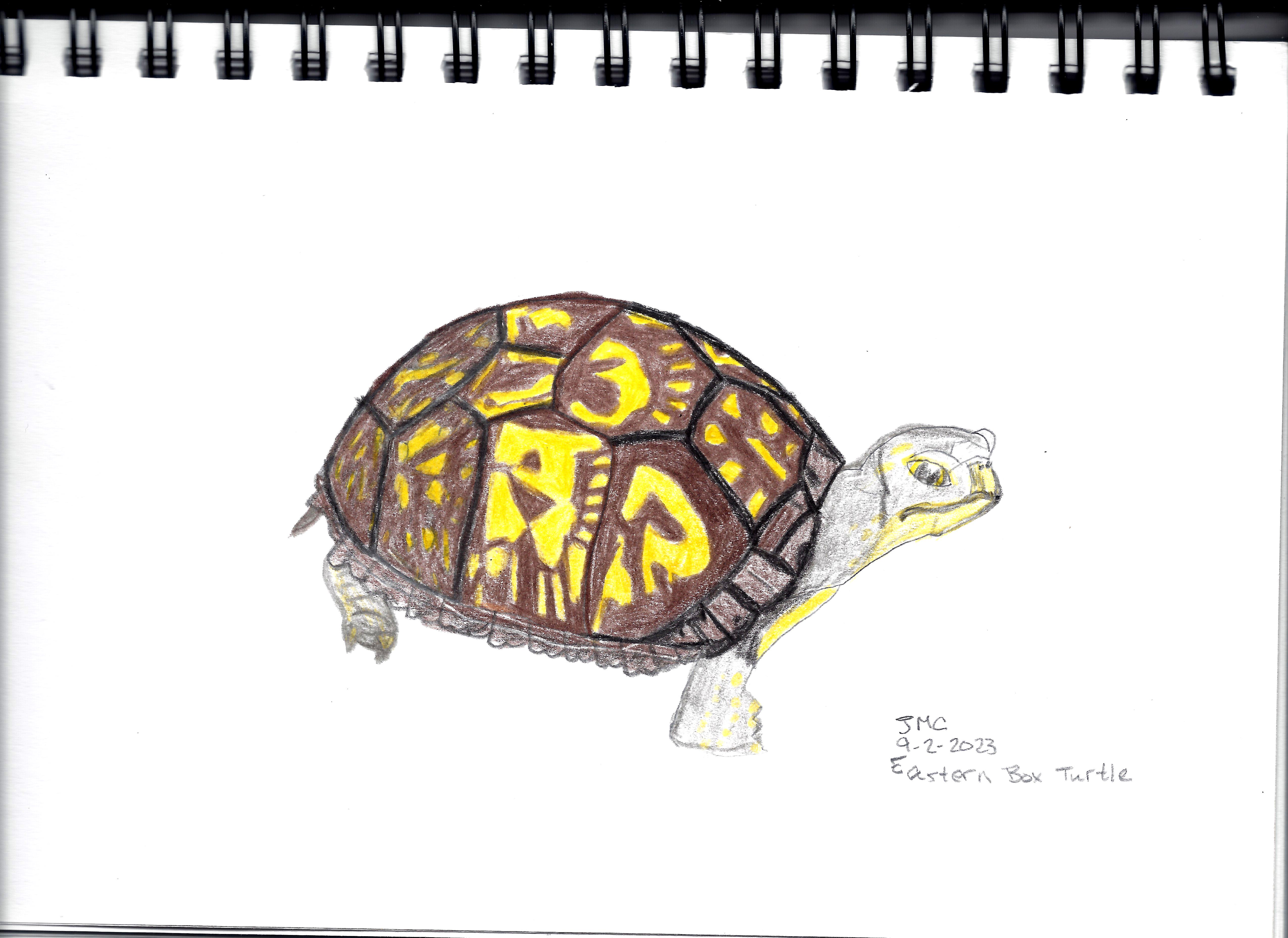
As we looked down at the watery obstacle we saw something move. Cassandra exclaimed proudly, “Look at all of the minnows, Jackie,” pointing at her new-found creatures. I looked down and saw them. There were a whole bunch of them, some swimming with the current and other minnows swimming against it. Cassandra was trying to catch them with her hands and just missed one when Grandma, with her arm outstretched, called out, “Oh, there’s one!” Our eyes followed Grandma’s hand and saw what she found. Trying to climb over some rocks and not having much success, was an Eastern box turtle (now it is called Woodland box turtle).
This turtle was Cassandra’s new treasure. She quickly ran over to it and picked up the small creature. As if by reflex, the turtle shot into its shell, sealing itself in. That is how the box turtle got its name. The turtle seals its shell up like a box for protection. It completely closes itself inside. Cassandra promptly named this turtle “Dimitri,” after a former turtle found in the same woods.
Approaching Another Obstacle
Before long we were back to following our quickly-moving trail. Cassandra was carrying her treasure, Dimitri.** Soon we came to a place where about five or six Tulip Poplar trees had fallen and blocked our way. “Now what do we do,” Cassandra questioned, her arms waiving in the air. Grandma quickly answered with, “We go over them.” She climbed up onto the first one and started to tell Cassandra and me some of what she knew about this kind of tree as we were climbing. “We have one of these trees on either side of the house,” she explained, “they get very big.” Some branches have broken off and landed on our roof. In the Fall I have to climb onto the roof to clean them off. While I am up there I clean off the leaves and flowers from the tree, too.”
Pondering a Tulip Poplar
I followed Grandma onto the first log and was ready to go on to the next when I stopped to look back for Cassandra. She was not even on the first tree. Cassandra couldn’t get onto it because the log came up to about her nose. She was not going to put down Dimitri to climb onto the tree trunk. I reached for the turtle so she could climb up and join us. It was fun to have a new obstacle, but they seemed out of place. All of these large trees seemed to be about the same size.
For the trees to be about the same size, and all in this one place across the creek did not seem right. I was trying to imagine why they would be here and what would have made them fall. Were they planted here on purpose and then, several years later, pushed down to form a kind of bridge across the creek? Tulip poplar trees grow fairly quickly. Were these trees planted by seeds, birds or another natural way? Then a lot of rain made their roots all give way and the all fell at the same time? I did not know why, but I am still baffled by those particular trees being at that specific spot, all lined up in a row.
I did not think to look at the roots to see if maybe strong winds knocked them over. Did they all collapse at once, that their roots were so clumped together. On the other hand, I did not notice if they had been intentionally cut down with a chainsaw. Whatever the reason, they were down and made for a more interesting trek.
Briar Maze
After pausing for a short break, it seemed like forever until we were back in the water again. We walked through unseen cobwebs and under briar bushes, following our narrow creek. The briar bushes got bigger and bigger and Cassandra made it clear that she did not like them at all. I had to agree with her, they seemed like an unnecessary evil. It was not long before we came to a place with tall grasses on one side and briars on the other. By this time the creek was so small we had to walk single-file. Cassandra looked ahead and saw nothing but briar bushes, hanging low over the creek. We crawled under most of them and over the rest. At one point I looked down and saw that my shirt was completely covered with thorns! Even though it was warm, I was thankful for my long-sleeved sweatshirt. Nevertheless, we continued; over and under briars and over fallen trees.
Another Notable Creature
Cassandra was getting pricked by thorns. She lost her balance and accidentally dropped her treasure, Dimitri. I bent down to pick the turtle up and as I looked up I saw two eyes about a foot away from my face. It was a dark colored snake, all curled up on some twigs by the bank. “There’s a snake,” I said, looking at the big wad of black and grey. It was probably not as big in real life as it is in my memory. “No,” Grandma replied, “you’re kidding.” She did not believe me at first until she glanced over at it. We kept going, Cassandra did not even notice it and Grandma wanted to get away from it. I was not too thrilled to have been face to face with a snake. Not knowing it was there, then being face to face with it, was startling to me. However, the snake was neat to see. I was grateful to be continuing our trek.
Cassandra was trudging through the thorns, each time saying how much she did not like them, until there was a place with rocks everywhere. She leaped from slippery rock to slippery rock, checking her balance on each one. After about five big rocks she jumped into the water, getting Grandma and me all wet. Also, she drenched her own shoes and socks in the process. The water had gotten more narrow and shallow. As Grandma, Cassandra and I ducked out from under a bush we recognized where we were. There was a nature park on the other side of Grandma’s neighborhood. Our small watery trail (the creek) had joined Laurel Run and led us to the small park off of Dennis Circle and Canyon Road. The park is called “Swatara Crest Park.”
Finish Line
Very pleased and smiling, Grandma turned to us and said, “Wow, isn’t that neat?! I never knew where the creek went or where we would end up.” We reached the finish line of our adventure. She was so pleased to have accomplished that challenge.
“Let’s look for minnows and salamanders,” exclaimed Cassandra. “What are you going to put them in,” asked Grandma. Cassandra just looked down into the water with anticipation. She was satisfied with Dimitri. We kept following the creek to the beginning of the nature trail, stopping here and there to flip over some rocks and to peek in some larger pools. Sadly, our time of exploration was almost done, as we had to get back to Grandma’s house to get cleaned up and for Grandma to start dinner.
Finding our Way Home
Finding the road, Grandma asked, “why don’t we go this way,” pointing to someone’s yard. Cassandra and I exchanged glances, not comfortable with going through a stranger’s yard. However, we followed Grandma nonetheless. There were about three yards and then a fence. “We can go the other way now,” I suggested. “It’s alright,” Grandma assured, “your mom used to baby-sit the girl that lived here.” Cassandra and I continued following Grandma to the other side of the fence. “I don’t like that you did that,” was the next thing we heard, coming from inside the house. Uh-oh, I gasped, feeling caught and in trouble. I was preparing myself to be lectured when Grandma replied, “Hi, how are you doing?” “Fine, and you,” we heard. By this time we (Cassandra and I) were up to the window and not knowing what to expect. Grandma’s kind demeanor and easy-going words were reassuring to Cassandra and I. We agreed to continue to her house as she was going to catch up with this neighbor for a few more moments. After we were all back at Grandma’s house, having dinner, we shared with Grandad the experiences of the day that we had.
**We did put Dimitri back in the woods, but not where we found him. We were unaware at the time that turtles should not be removed from their home. It is imperative to leave them where you find them, unless, of course you are getting them safely across the road. Also, it is illegal in Pennsylvania to take them from the wild.
“Praise the LORD! Praise the LORD from the heavens! Praise him from the skies! Praise him , all his angels! Praise him, all the armies of heaven! Praise him, sun and moon! Praise him, all you twinkling stars! Praise him, skies above! Praise him, vapors high above the clouds! Let every created thing give praise to the LORD, for he issued his command, and they came into being. He set them in place forever and ever. His decree will never be revoked. Praise the LORD from the earth, you creatures of the ocean depths, fire and hail, snow and clouds, wind and weather that obey him, mountains and all hills, fruit trees and all cedars, wild animals and all livestock, small scurrying animals and birds, kings of the earth and all people, rulers and judges of the earth, young men and young women, old men and children. Let them all praise the name of the LORD. For his name is very great; his glory towers over the earth and heaven! He has made his people strong, honoring his faithful ones-the people of Israel who are close to him. Praise the LORD!” (Psalms 148:1-14, NLT)
Painting or dyeing eggs around Easter is a popular activity. Simple or extravagant, many eggs are decorated for this holiday. When I was growing up I did not paint wooden eggs. I did, however, color real eggs a number of ways.
Types of Eggs
One way to decorate eggs was to use a blown egg. A blown egg is a real egg with the inside cleaned out. For those eggs, we used acrylic paint and a cotton swab as a brush. They are very fragile but can last for many years, if handled with care. My mom has some that are 25 or more years old!
Another type of egg decorating uses hard boiled eggs. However, hard boiled eggs need to be refrigerated shortly after being boiled. To decorate those, we would use a mixture of color tablets, vinegar and water. The eggs would be submerged into the mixture up to five minutes. When removed and dried, the eggs were dyed whatever color the mixture was. We used a clear crayon to draw crosses or designs or to write a name. The dye resisted the crayon marks. Therefore, whatever was drawn on the egg would show up.
Choosing Wooden Eggs
My kids don’t all enjoy eating hard boiled eggs. Therefore, we don’t make too many of them, otherwise we would end up wasting many eggs. Also, my kids are not ready for blown eggs. They are not gentle enough and would crack the fragile eggs. I decided to begin a new tradition with our family. They decorate wooden eggs. Every year they each paint one egg. The wooden eggs last for a very long time. Also, they are not fragile and easily broken like the blown eggs. My boys each have their own collection of painted wooden eggs.
Decorating Wooden Eggs
I purchase wooden eggs from a craft store, such as JoAnn Fabrics. If the base of the egg is round my husband sands it down. My boys use acrylic paint, either matte or gloss. After they are finished painting we put all three eggs on a paper plate to dry. After about 30 minutes I pick up each egg then set it back down on the plate. That is to make sure it does not stick to the plate while it is drying.
When the paint is completely dry, in about 24 to 48 hours, I coat each egg completely in mod podge. I like to use some with a gloss finish. Then, when that is completely dry, I use a permanent marker to write their name and the year on the bottom of the egg. Sometime after Easter we put the wooden eggs into cardboard egg cartons for storage. Each year my kids are eager to look at their eggs from the previous years. I like to see their creativity and how they change each year. None of the eggs are exactly the same. Their preferences in colors and designs change year after year.
“The next day, the news that Jesus was on the way to Jerusalem swept through the city. A large crowd of Passover visitors took palm branches and went down the road to meet him. They shouted, ‘Praise God! Blessings on the one who comes in the name of the LORD! Hail to the King of Israel!” (John 12:12-13, NLT)